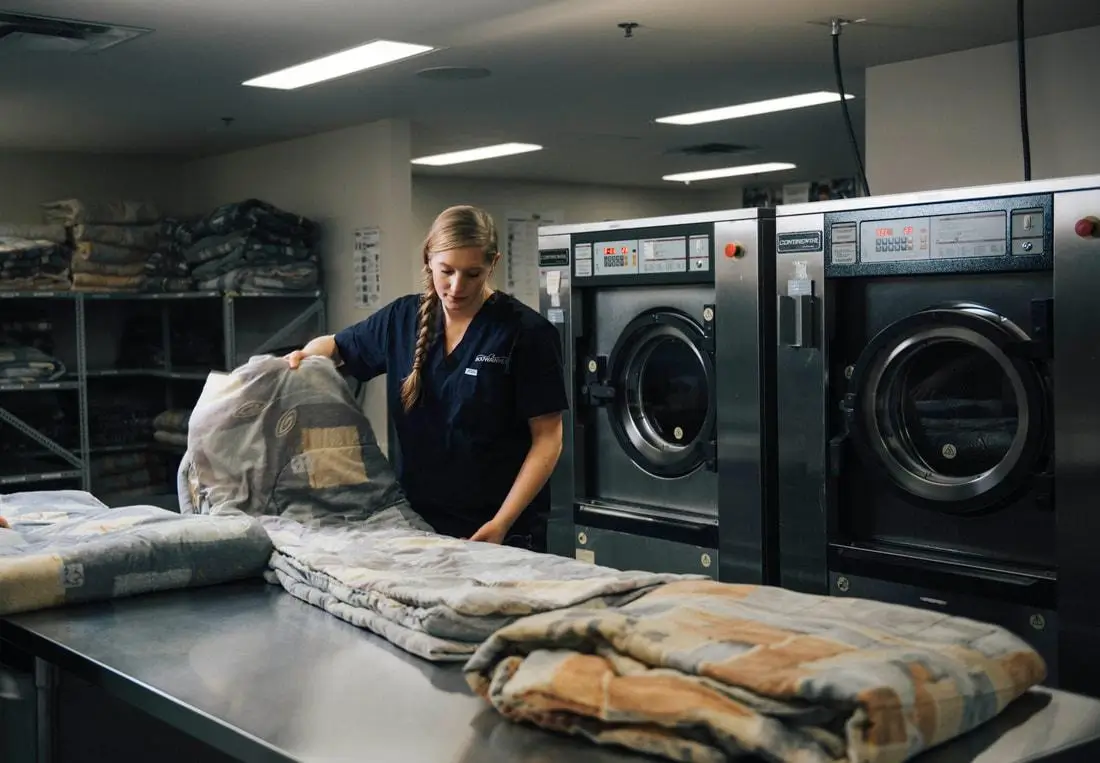

If you run an office or hostel, laundry is not a “nice to have.” It’s an operational system. If it breaks, complaints spike within 48 hours.
This Commercial Laundry Guide will help you decide whether to outsource, build in-house, or run a hybrid model. I’ve done all three. Each has trade-offs you should understand before spending your first rupee.
The Commercial Laundry Guide starts with one decision: outsource or build in-house
Start with this. Everything else depends on it.
If you have under 80 users (employees or residents), outsourcing is almost always cheaper and simpler.
If you have 100+ daily laundry loads, in-house starts making financial sense.
Here’s how it usually breaks down:
Outsource
-
Cost: ₹40–₹90 per kg (India average, varies by city)
-
Setup time: 2–5 days
-
Zero CapEx
-
Risk: service inconsistency
In-house laundry
-
Setup cost: ₹2.5 lakh – ₹8 lakh for basic setup
-
Per kg cost: ₹18–₹35 after stabilization
-
Break-even: 6–12 months
-
Risk: operational headaches
Hybrid (most underrated model)
-
Daily loads handled in-house
-
Bulk or peak loads outsourced
-
Best for hostels with fluctuating occupancy
Real scenario: We ran a 120-bed hostel. Outsourcing looked easy. But complaints about delays hit 15% weekly. We moved to hybrid. Complaints dropped to under 3% within a month.
How laundry demand actually looks in offices vs hostels
Do not assume demand is steady. It isn’t.
Offices
-
Average usage: 0.5–1.2 kg per employee per week
-
Peak days: Monday and Friday
-
Items: uniforms, pantry linen, towels
Hostels
-
Average usage: 2–4 kg per resident per week
-
Peak days: weekends
-
Items: clothes, bedsheets, towels
Data point: According to the International Fabricare Institute, commercial laundry usage in residential facilities can be 3x higher per user compared to office environments.
If you size your system based on averages, you will fail on peak days.
How pricing works in a Commercial Laundry Guide (and where people get it wrong)
Most people price wrong. They either undercharge or ignore hidden costs.
Standard pricing models
-
Per kg pricing → ₹30–₹80/kg depending on city and volume
-
Per item pricing → Shirt: ₹10–₹25, Bedsheet: ₹20–₹50
-
Subscription model → ₹800–₹1500/month per user
Hidden costs people ignore
-
Water: ₹20–₹60 per 1000 liters
-
Electricity: ₹6–₹10 per unit
-
Labor: ₹12,000–₹18,000 per operator monthly
-
Detergent + chemicals: ₹5–₹8 per kg
Real number: Your actual in-house cost rarely goes below ₹22/kg.
We once tried cutting detergent costs by 20%. Clothes started coming back with odor complaints within 3 days. That experiment ended quickly.
Equipment choices decide your long-term cost, not just your setup cost
Do not buy machines based on price alone.
Minimum viable setup for 100 users
-
2 commercial washing machines (10–15 kg capacity each)
-
1 hydro extractor or spin dryer
-
1 tumble dryer
-
1 steam press or flat iron setup
Cost range (India)
-
Washing machine: ₹80,000–₹2 lakh each
-
Dryer: ₹1 lakh–₹2.5 lakh
-
Pressing setup: ₹25,000–₹1 lakh
Data point: Energy-efficient machines can reduce electricity consumption by up to 25% (U.S. Department of Energy).
That matters. Your electricity bill becomes your second-largest expense after labor.
Operations break when you ignore workflow design
Machines don’t fail first. Process does.
A simple, working workflow:
-
Collection (time-fixed)
-
Sorting (by color + fabric)
-
Washing batches
-
Drying
-
Folding / ironing
-
Distribution
Where most setups fail
-
No tagging system → lost clothes
-
No batch tracking → delays
-
No cutoff time → chaos
Use simple tools:
-
Google Sheets for tracking (works till 200 users)
-
Barcode tagging if scaling beyond that
-
Apps like CleanCloud or LaundryOS
Service quality matters more than speed after week one
People forgive a 24-hour delay. They don’t forgive damaged clothes.
Common complaints
-
Color bleeding
-
Shrinkage
-
Missing items
Data point: Over 60% of complaints are quality-related (Textile Rental Services Association).
Train your staff. One wrong wash cycle can ruin 20 clothes in a batch.
The Commercial Laundry Guide reality: outsourcing vendors are inconsistent
Outsourcing looks easy. It isn’t stable.
What goes wrong
-
Pickup delays
-
Mixed loads
-
Last-minute cancellations
How to control it
-
SLA with penalties
-
Keep 1 backup vendor
-
Maintain buffer inventory
Real case: Vendor missed pickups for 2 days during monsoon. No backup. That week caused 30% churn in a hostel.
Turnaround expectations are rising, including demand for same day laundry service in India
Standard turnaround is still 24–48 hours. That’s what most systems can handle reliably.
But users are now expecting faster delivery, especially in urban setups. The demand for same day laundry service in india is increasing, but it only works if you have spare capacity, strong workflow control, and higher pricing to support the load.
If you promise speed without capacity, delays will stack up within days.
Technology helps only after operations are stable
Don’t build an app on day one.
Start with:
-
WhatsApp orders
-
Google Sheets
-
Fixed schedules
Then scale:
-
User app
-
Wallet system
-
Vendor allocation
Tech improves tracking. It does not fix bad operations.
Compliance and hygiene are non-negotiable
You are handling personal clothing.
Checklist
-
Disinfect bedding properly
-
Separate contaminated loads
-
Maintain water quality
WHO recommends washing at 60–90°C for proper sanitization.
What this system does NOT solve
-
It won’t eliminate complaints
-
It won’t run unattended
-
It won’t stay profitable below 60% occupancy
Laundry is volume-driven. Low usage kills margins.
FAQs
How much does it cost to start a commercial laundry setup for a hostel?
₹3–₹6 lakh for 80–120 users. Lower budgets usually increase maintenance issues later.
Is outsourcing better than in-house?
Works under 80 users. Beyond that, hybrid or in-house models perform better.
How do I reduce complaints in laundry services?
Focus on sorting, labeling, and staff training. Most issues come from process errors.
What turnaround time should I offer?
24–48 hours is reliable. Same-day should be limited and priced higher.
How profitable is a commercial laundry system?
Margins range from 15% to 35%, improving after 100 kg/day volume.
Final call to action
Don’t start with machines. Start with demand, capacity, and workflow.
If you want, share your user count and setup type. I’ll map the exact cost model and system for you.